
You're Good at Your Job Until Someone Triggers You
Stop letting your nervous system sabotage your professional life
You're competent. You're capable. You've earned your position.
But:
- A critical email sends you into a spiral that lasts for hours
- Your boss's tone makes you shut down or get defensive
- Workplace conflicts replay in your head all night
- Pressure turns you into someone you don't recognize
- You can't turn off the work stress, even when you're home
You know you're overreacting. You can see yourself doing it. But in the moment? You can't stop it.
Here's what happens when we're triggered

. . . Once you're triggered alarms bells pulse throughout your body. You move into fight or flight via the nervous system.
. . . That "charge" compels you to take action . . .

You quickly leave the scene to heal your wounds and hide in safety or you react outwardly with anger. Neither action fixes the problem. You're left feeling shaken and your ability to think clearly and be emotionally steady is now clearly compromised.

. . . The fallout of being triggered can last for days. Perhaps you're easily moved to tears or unusually tired. If you're unable to shift your mood you may feel shut down and numb all over.
. . . You might attempt to shift your mood by telling yourself: "I'm making a big deal out of nothing" . . . a move that unfortunately may come back to haunt you.
Being triggered by anxiety and unprocessed trauma . . .

. . . Workplace expectations and interactions can feel overwhelming when you're being triggered by unresolved childhood trauma.
". . . When your job is your only livelihood the pressures can feel intense."
The real problem
Here's what's really happening:
Workplace dynamics—authority figures, criticism, pressure, conflict—activate the same survival responses that were wired into your nervous system years ago.
Your colleague's passive-aggressive comment isn't the real problem. It's that your body is responding as if you're back in a situation where you weren't safe, valued, or heard.
Your nervous system can't tell the difference between a tense meeting and an actual threat. So it floods your body with the same fight-or-flight response.
The solution
But here's the good news: nervous systems can be retrained.

Dr. Susan LaCombe, 30 - Year Veteran, Psychologist and Rebel Shrink, Publisher of myShrink.com
I'm Dr. Susan LaCombe, psychologist and somatic specialist. For 30 years, I've worked with people who've "tried everything" and are still struggling with triggers.
Eliminate Workplace Triggers (with DeCoding the Brain) isn't another course about understanding your emotions. It's a nervous system retraining program that eliminates triggers at their source—through proven somatic techniques that work with your body, not just your mind.
- A password protected, Psychologist-Designed platform for eliminating triggers through emotional regulation training.
- 24/7 Emotional Support: Functions like an app and provides tools to address any trigger and fit any situation for alleviating emotional distress. Designed for continuous use, it empowers you to manage your emotions and well-being anytime, anywhere.
- Developed by Psychologist Dr. Susan LaCombe and fine-tuned with feedback from over 600 users since 2012.
- Win Bonus Courses through Gamification: Core ideas delivered through 4 different levels.
- Dozens of actionable steps to fit individualized needs. Includes interactive elements for enhanced hands-on learning.

Bea... | better therapy member (unsolicited feedback)
GAME CHANGER!
Hi Susan,
Thank you so much for the Program! Becoming aware of my activation has been a GAME CHANGER! I've done so many courses and workshops over the years but this was by far the MOST EFFECTIVE course I have ever done!
I'm so grateful for everything you taught me!!
Best regards,
Bea
sandra...member| (unsolicited feedback)
USED IT FOR COUNTLESS OTHER SITUATION
Roughly 2 years ago... I decided to do the Brain Coaching Program [Currently called DeCoding the Brain]. It was one of the best things I've ever done, and I do mean that. Apart from it being so interesting it proved so effective and helped me in many areas. The wonderful things was I could apply techniques and strategies taught to countless situations in my life.
Now, having been away from the program for a while, I've decided to return and do a complete refresher course!
Thanks again.
Sandra
Elspeth... | member
YOUR PROGRAM IS LIKE THERAPY FOR ME
Hi Suzanne, I've really enjoyed this first week. Being your client for some years now, I find this course a practical way to spend more time "in therapy" on-line as I live on an island and can't always get in for sessions. The Brain Coaching Program [DeCoding the Brain] is so worthwhile and you have done a marvelous job of putting this together to give an understandable process to help us heal from life. Your videos bring you right in front of me as if we were in session.
Thank you.
Elspeth
DeCoding the Brain* is delivered sequentially through 4 levels so you're never overwhelmed. With lots of tips and strategies for dealing with different moods and mindsets, you always know what tool to use to get out of a negative state.
[*DeCoding the Brain was previously known as the BCP or the Brain Coaching Program]
doris s. ... | member/unsolicited feedback
TURNED MY LIFE AROUND
"I have a most wonderful life and I love it!" This is the shortest way of me expressing how timely, fitting, tailor made, completely appropriate and helpful your program was and is, and (I am sure of it) will be. It has helped me turn my life around, make lasting changes to the quality of my life, and you have most certainly kept your initial promise!"
Doris
Eliminate Workplace Triggers
with DeCoding the Brain
Makes Science Simple
Not only does this program offer the tools and strategies for shifting out of these states, (including user-friendly explanations from neuroscience of WHY you're dealing with these problems in the first place), it has several accountability tools to keep you on track.
INTERACTIVITY, ACCOUNTABILITY & HANDS-ON LEARNING
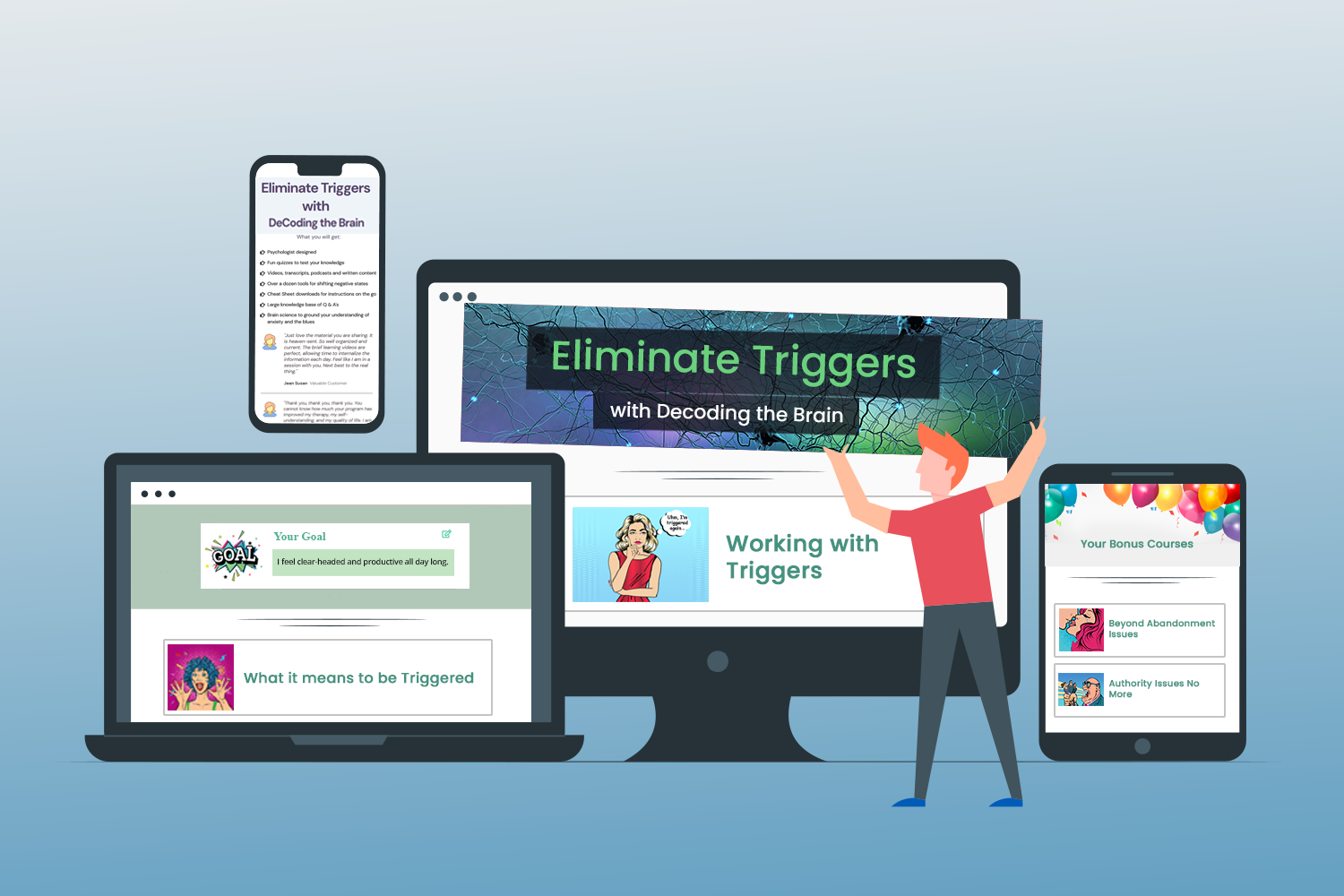
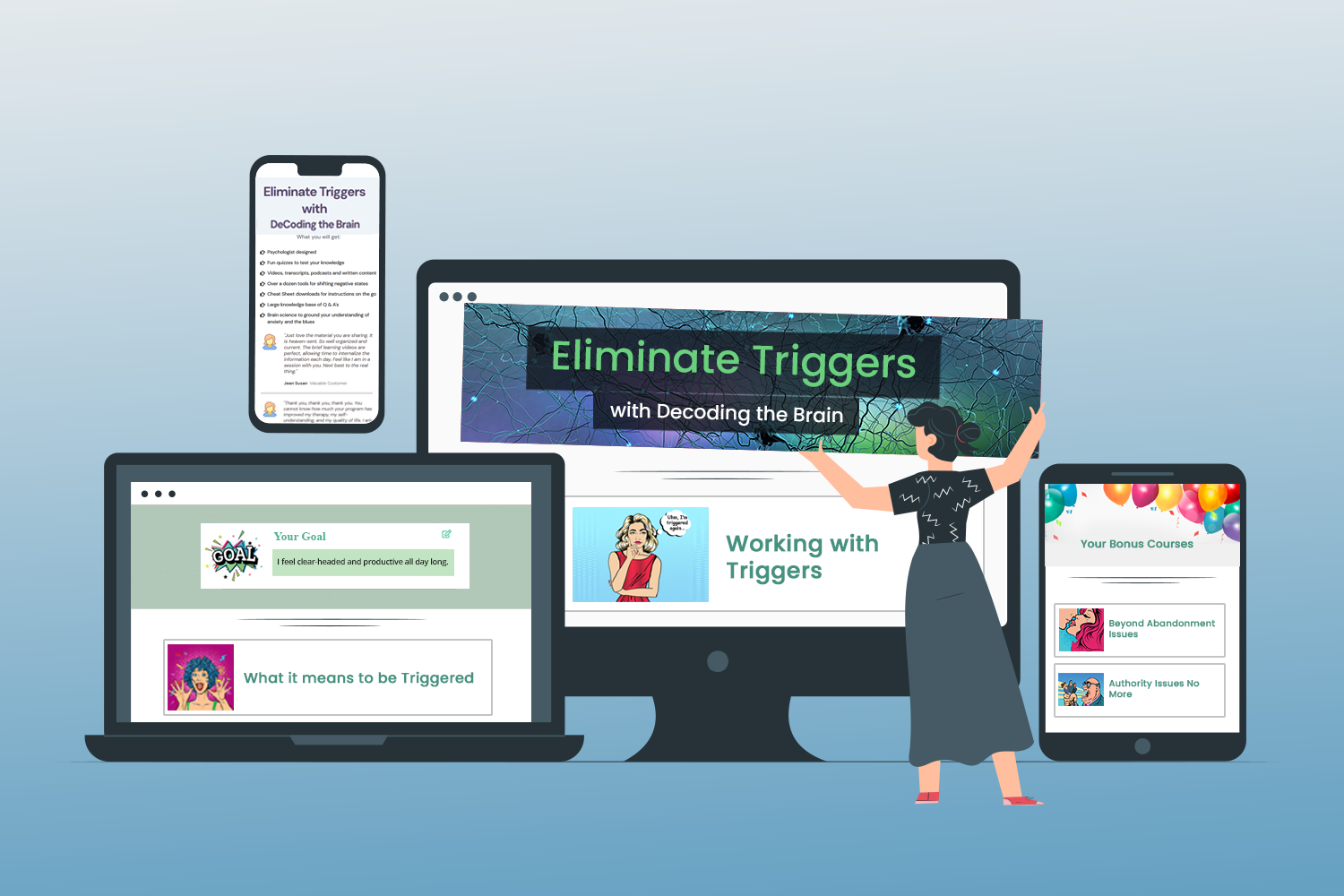
Being able to absorb what you're learning—especially in regards to applying that knowledge—is usually made much easier when you interact with the material. For this reason, DeCoding the Brain includes several ways to track your progress and keep you inspired. Aside from the quizzes, progress bars and interactive pages, these elements below were created to keep you on track.
The purpose of DeCoding the Brain is for you feel better NOW. Deepening your understanding of why you're feeling better is secondary to that first purpose.
So while there's plenty of material available to you, the focus is not in getting through it all. Sometimes you'll just jump inside to find the right exercise to deal with a negative or nasty state. After all, feeling much better—even if you don't know why—is the ultimate goal.
However, for those left-brainers out there  once you do complete the coursework for any given month, we wanted to reward you. And just to make it fun, each time you get to pick from among several topic-specific Bonus courses.
BONUS COURSES:
Beyond Abandonment Issues
What It Means to be Triggered
Freedom After Trauma
Easy-to-do Challenges. The Challenges are friendly prompts to use your tools daily (and gain points for Bonuses). You'll find it handy to have all the exercises listed in one place as a reminder of what's available to you.
When you're trying to establish new habits, it's motivating to see how much you've changed from where you started from. The Tracker Tool is something you'll look forward to doing each week—and it only takes a minute of your time. This feature keeps a record each time you record your current physiological state.
Even using The Tracker Tool the one time, is an eye-opener. You'll be amazed to learn how many so called "symptoms" are merely variations of ONE problem. (Yes, you don't have a gazillion issues to deal with—working on your nervous system solves many issues—even things you thought you had to deal with for the rest of your life. NOT.
As well, you also have an Online Workbook to record your roadblocks, successes and to note the events that you find challenging. This feature comes in handy as it's not always easy to keep track of events that might be triggering. You can use your workbook as a starting place from which to unpack a trigger (ie. getting at the true source of the trigger and the ideal healing scenario that helps you move beyond it).
Finally, every page offers a place to record notes - with the click of a button. Here you can record insights and questions about your growth in relation to the topic you're reading. Many members use this feature to copy verbatim relevant passages. (Your notes are listed on one page in your Workbook.)
NEW FEATURE. Sometimes, you have a burning question and can't wait to get the answer. That's when specific replies to your query comes in handy. Once you obtain sufficient points (by doing Challenges and completing tasks) you can use your Bonus points to receive a personalized video reply from Dr. LaCombe to your video, audio or written question. (This is just one of the many Bonuses to choose from.)
Gay.l. ... | Founding member
NOW I HAVE TOOLS TO DEAL WITH MY FEELINGS
"The BCP [DeCoding the Brain] is helping me understand my core self in a way never before explored and is giving me tools to move through feelings & experiences I have always thought were in control of me, triggering panic and fear that would last for days... brain based and scientific."
Gay L.
My promise to you . . .
GUARANTEED SATISFACTION

You have my 14-day Unconditional Guarantee of satisfaction. I’m confident that you’ll find Eliminate Workplace Triggers eye-opening, powerful and effective.
Personalized Service: to the degree it's possible in an online program, I want you to know you're not alone in this journey. I'll be there with you.
Please know, if you don’t feel like you’re getting the value you expected, or if you’re just not able to follow through on these science-based solutions no matter how hard you try, then just click the 'Cancel' button within 14 days and I’ll refund your purchase (See below for more details).

ELIMINATE WORKPLACE TRIGGERS
. . . a science-based solution for
eliminating triggers

Popular
Play-Full Parenting
with
DeCoding the Brain
$
79
$79.00 Today
$19.95 monthly (Starting in 90 days)
Tina f. ... | member (unsolicited)
SO HELPFUL!
I hope you don't mind me emailing you like this. I just wanted to say I purchased your course and it's been extremely helpful. I'm up to the part about releasing anger and it's something I've needed help with for a while. Thank you for these amazing techniques and information, it has all been so helpful!
Best,
Tina F.